
Published on July 23, 2025
Quantum technology – still basic research or already a leap forward in innovation?
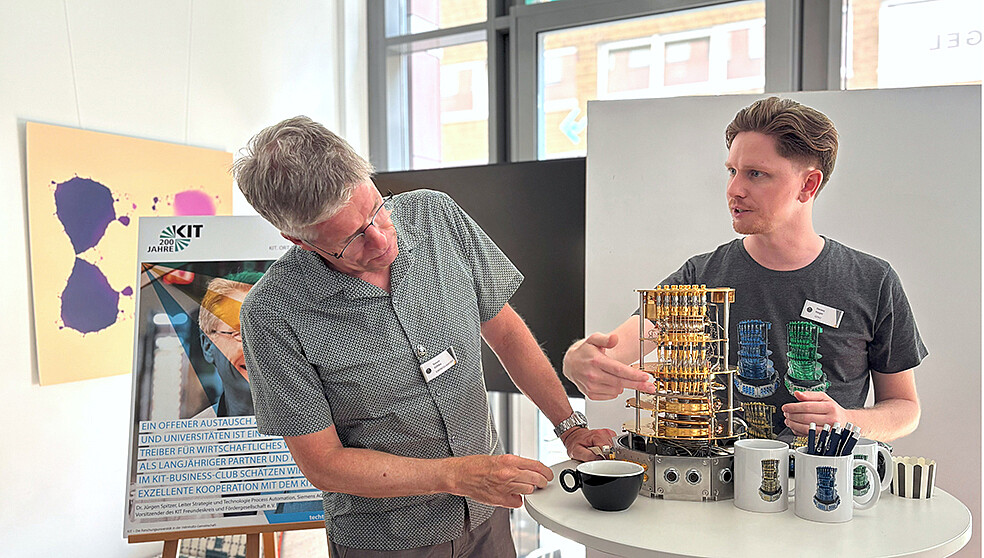
The idea that our world is fundamentally based on quanta is over 100 years old. Physicists formulated the theory of quantum mechanics as early as 1925. Science is now celebrating the international Year of the Quantum in 2025 – an occasion that the KIT Business Club also took up to look at current developments in quantum technology as part of the NEULAND Knowledge Week. Although the foundations were laid over a century ago, significant progress is now being made in practical applications – whether in quantum computing, sensor technology or secure communication. The KIT Business Club clarified where we currently stand at the "Quantum Technology Update" on July 1, 2025 at TRIANGEL Karlsruhe. Contributions from science and industry gave members an update on the theory and practice of quantum technology hardware and software.
Quantum as a topic of the future
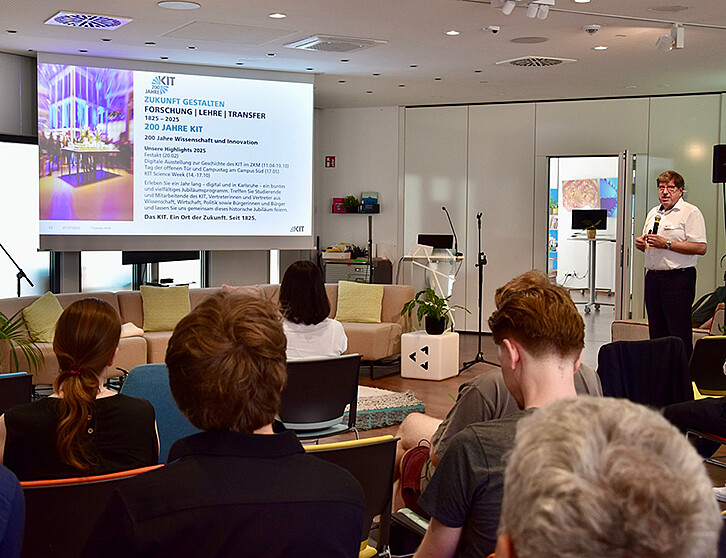
Right at the beginning, Prof. Thomas Hirth, Vice President Transfer and International Affairs at KIT, emphasized the central importance of quantum technologies as an important focus area for KIT in his keynote speech. Quantum solutions are being researched in several institutes. A recent report by the Commission of Experts for Research and Innovation (EFI) underlines this course: The establishment of a research and innovation ecosystem in the quantum field and the transfer of scientific findings into innovative, marketable products are of great interest to the entire German economy.
Control over the smallest
In his lecture, Prof. David Hunger from the Physics Institute (PHI) explained that it is already technically possible to manipulate individual quanta in a completely controlled manner. A basic requirement for many applications. Quantum-based encryption methods have already been in use in cryptography for some time. However, Hunger's current work is concerned, among other things, with the next size scale, the implementation of quantum communication in larger networks up to the quantum internet. A test track was recently set up at KIT for this purpose, where various new technology modules such as quantum memories or quantum repeaters can be used and tested.
Hybrid approaches for real problems
Quantum computers promise to solve certain problems much faster than conventional computers – by making targeted use of quantum mechanical effects. However, it is not easy to identify which tasks these are in detail and how subtasks of a more complex problem are most effectively divided between classical and quantum-based methods in practice. Both Domenik Eichhorn, who researches quantum computers at the Institute for Information Security and Reliability (KASTEL), and Stefan Knipp, who has gained practical experience with quantum technology at Thales, share this view. Domenik Eichhorn is therefore currently focusing his research on meta-solving concepts and approaches: his aim is to develop hybrid solutions for complex problems that combine the best of both worlds.
Quantum superiority within sight?
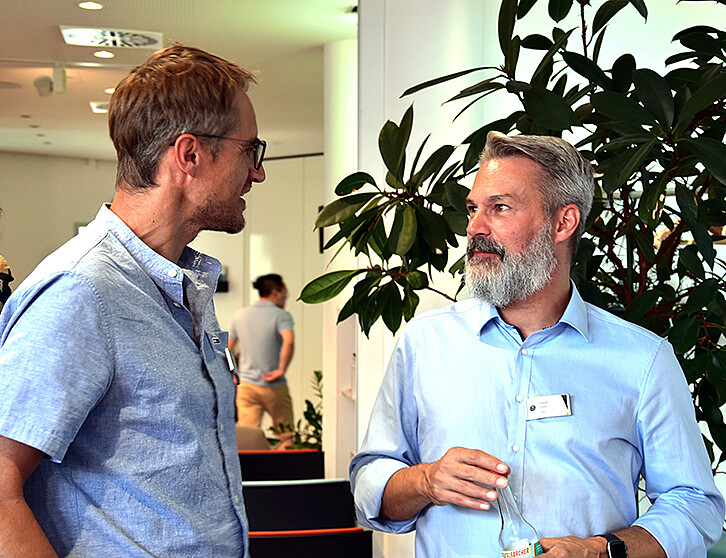
In his presentation, David Faller (IBM) explained that we are already close to a world of quantum computing with real quantum superiority. IBM has been pursuing an ambitious timeline for the development of application-ready quantum computers for years and is right on schedule. He dispelled just one notion: A quantum computer will probably not shrink to the size of a desktop system any time soon – the infrastructure and cooling requirements are too high for that.
Software meets hardware
The diversity of contributions at the event reflected how many disciplines need to come together in quantum technology. Eileen Kühn, Scientific Computing Center (SCC), and Michael Marthaler, founder of HQS Quantum, explained exciting examples at the interface between quantum computers and software, with reference to the use of machine learning methods on the one hand and consulting and the application of simulations on the other. The hardware side was not neglected either: while Dennis Rieger (spin-off QINU) discussed the hardware for cooling quantum computers, Sören Ihsen and Simon Geisert (both from the Institute of Quantum Materials and Technologies (IQMT)) presented a new design concept for a quantum circuit.
Quantum applications on the rise
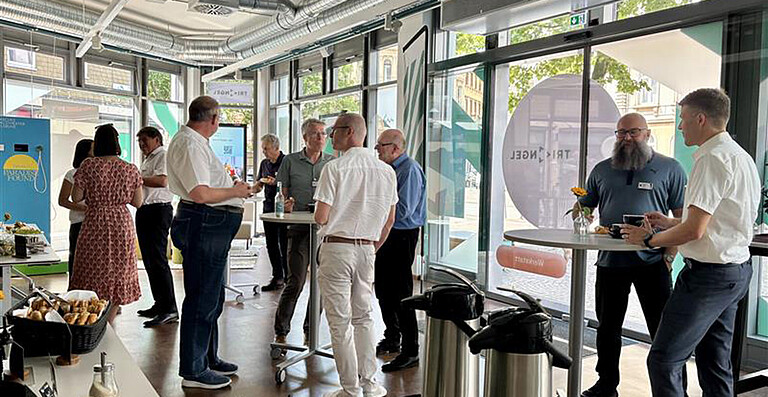
The event made it clear to all participants that a functioning quantum world requires far more than just basic research. A whole range of technologies and a suitable innovation ecosystem are needed in which materials, chips and system technology, computer architectures, software and software concepts are thought through and developed together. With the Quantum Technologies Update, the KIT Business Club not only offered a comprehensive insight into the current status, but also a platform for exchange between science and industry on the topic. As always in the field of innovation, cooperation with other players and the establishment of a network in which ideas can be exchanged and mature play a decisive role.
comments about this article
No Comments