
Published on March 05, 2026
Carbon-free PoWer for agricultural and construction machinery

A combine harvester knows no rest during harvest season. When the grain is ripe, there is only a short window of opportunity to harvest it – often just a few days. Rain or strong winds can quickly compromise or render the crops unusable. That's why powerful agricultural machinery runs around the clock when necessary. Under difficult harvesting conditions, it consumes up to 1,400 liters of diesel per day to perform field work in dusty, hot conditions and under continuous load. "Carrying this enormous amount of energy in the form of battery storage is virtually impossible in the field of off-road machines," says Dr. Uwe Wagner, who works with alternative fuels as a group leader at the Institut für Kolbenmaschinen (IFKM) at KIT. "Even taking into account engine efficiency, a battery would be a factor of at least five heavier or larger than a comparable diesel tank," Wagner continues. The energy density of batteries is not sufficient to match the performance and runtime of diesel engines. And even if this were the case, the charging times during harvesting would not be economically viable. Electrification is therefore not practical for heavy commercial vehicles. However, users and manufacturing companies are aware that fossil fuel drives are not sustainable or acceptable in the long term. The energy and mobility transition does not stop at agriculture. This is precisely where the project "PoWer – Potential of Hydrogen Engines for Efficient and Robust Off-Road Applications" comes in. Together with industry partners such as MAHLE, DEUTZ, CLAAS, and others, KIT is investigating how hydrogen engines for agricultural and construction machinery can be made efficient, durable, and practical.
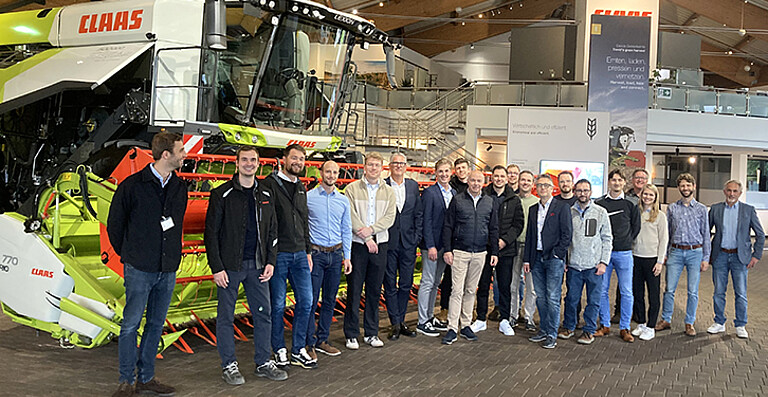
The future drives H₂eavy Duty
The PoWer project team is focusing on hydrogen as an energy source for heavy-duty applications, i.e., high-performance drives under extreme conditions. "The appeal of hydrogen is that it is carbon-free. When we burn hydrogen, it does not produce CO₂, but water, which does not pollute the environment per se. In many heavy-duty applications, the combustion engine is at least on par with a fuel cell in terms of efficiency – in some cases even better," explains Wagner. "With a combustion engine, it almost doesn't matter how dusty it is in the field. It is very robust against dust and temperatures, while fuel cells are much more sensitive in this respect. That's why we rely on combustion engine technology," adds colleague Jürgen Pfeil, group leader for optics and oil circuits at IFKM. Other factors speak in favor of a hydrogen combustion engine competing with today's diesel engines: high continuous power, long service life, short refueling times, and the possibility of further developing existing engine architectures.
From diesel to hydrogen – more than just a fuel change
The starting point is a proven diesel engine provided by partner Deutz. Although the project partners are not starting with a blank slate, hydrogen as a fuel changes the rules of the game. The combustion chamber geometry of a diesel engine is not ideal for a hydrogen gasoline engine. Due to the nature of the process, diesel engines operate with high compression. This means that the air in the cylinder is highly compressed before the fuel is injected and a heterogeneous mixture is formed. "Since hydrogen engines are preferably operated with homogeneous mixtures and hydrogen ignites much more easily, this compression is too high. It would lead to uncontrolled self-ignition, which manifests itself as pre-ignition or knocking. To avoid this, we have to reduce the compression ratio, redesign the combustion chamber, and develop a suitable injection strategy. That's why we're optimizing the engine not only for efficiency but also for safety – without having to accept any loss of efficiency," says Wagner, explaining the complexity.
Materials under hydrogen stress
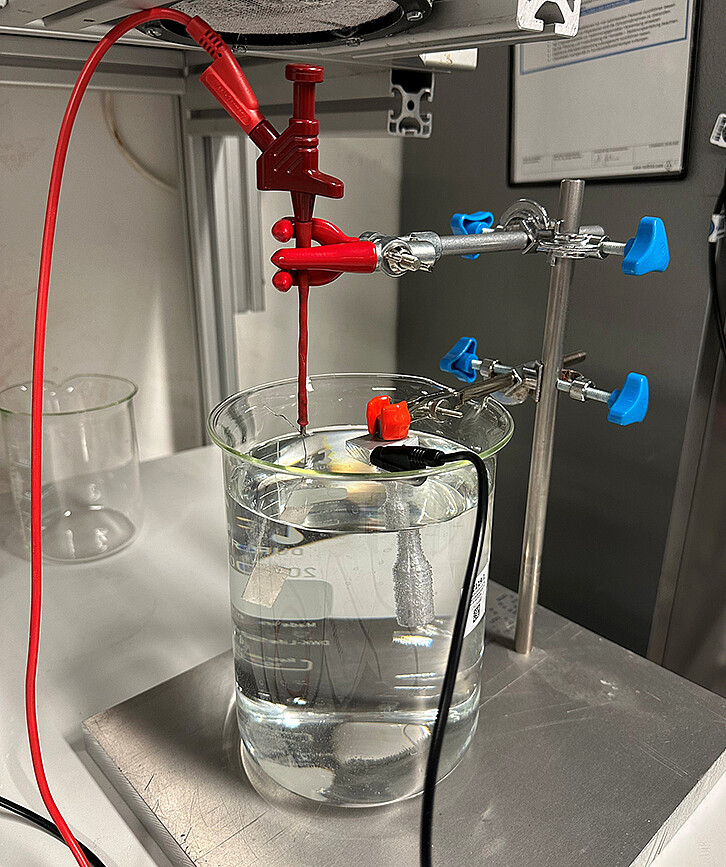
Hydrogen also affects the material in the engine when it comes into contact with it. Dr. Stefan Guth, laboratory manager at the Institute for Applied Materials (IAM), explains: "Hydrogen is challenging in terms of materials technology. It diffuses into metallic materials and causes what is known as hydrogen embrittlement – a reduction in formability that can lead to brittle fracture and, in engine operation, to a shorter service life." At PoWer, Guth and his materials science team are investigating typical engine and exhaust components under cycling loads. The researchers are testing different steels, cast iron, and other materials after electrolytic hydrogen loading: samples are placed in an electrolyte bath, specifically enriched with hydrogen, and then mechanically loaded in alternating cycles, e.g., in tensile-compression tests, until fatigue failure occurs – a test under extreme conditions. "We are observing reductions in fatigue strength of around 25 percent. This does not automatically mean the end for the material, but it does change the design. The aim is to develop reliable recommendations for action for our industry partners. We are continuing to investigate whether coatings or alternative alloys can reduce the negative effects of hydrogen," says Guth.
Why hydrogen engines raise new exhaust emission issues
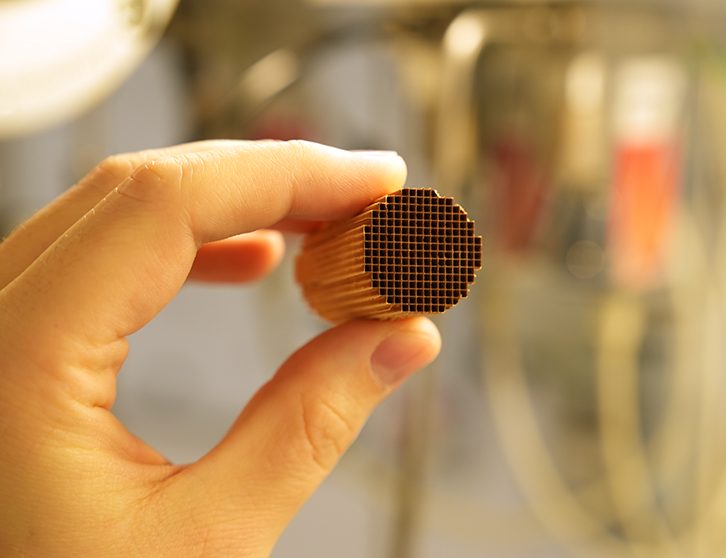
Hydrogen engines do not emit CO₂, but high combustion temperatures can still lead to the formation of nitrogen oxides (NOₓ). “CO₂-free does not mean emission-free,” Dr. Patrick Lott from the Institute of Technical Chemistry and Polymer Chemistry (ITCP) points out. A particular challenge arises from the high water content in the exhaust gas, which can be as high as 25 percent. Hydrogen burns into water vapor – and this water vapor makes it difficult for conventional catalysts based on nanoscale metal particles to decompose nitrogen oxides. The many water molecules are deposited on the tiny nanoparticles, changing the surface structure. The reactive surface is reduced. This decreases the effectiveness of the catalyst and its ability to break down the pollutant. Lott and his team are looking for solutions as part of PoWer: catalyst materials that remain tolerant of water-containing exhaust gases without losing their effectiveness. “We provide the atomic understanding and kinetic insights on a laboratory scale on how established exhaust gas technology can be adapted to the new application. Copper and iron zeolites, for example, deliver very good results as catalysts,” reveals Lott. In addition, the researchers are testing a completely new idea: whether the engine could use the existing hydrogen itself as a reducing agent to reduce nitrogen oxides – without AdBlue. “That would be an elegant solution because we would not need an additional urea tank,” says Lott. These approaches are being used to develop complete catalyst systems for the planned demonstrator in collaboration with industry partners Purem, NGK, and Umicore.
System thinking instead of single optimization
By the end of 2027, a functional engine prototype should be integrated into an agricultural machine from partner CLAAS: a hydrogen-powered off-road engine with an optimized combustion chamber, validated materials, and an adapted exhaust after-treatment system. Beyond the work at KIT, the focus is not only on the individual components of the engine, but also on the entire vehicle and infrastructural issues such as component manufacturing, vehicle integration, and safe fueling infrastructure. Regular consortium meetings at the partners' sites – from the engine plant to the combine harvester production facility – ensure that theory and application remain closely interlinked. “When we see where our developments will be used later on, the research takes on a whole new dynamic," says Lott. Everyone is working toward a common vision: it's not just about clean air, but about a practical technology that pays off. "Users don't really want to lower their sights. They don't want a compromise solution, but a real replacement for diesel. If the hydrogen combustion engine delivers the same performance with lower emissions and comparable costs, then it's a real game changer. Especially where batteries are not enough: in heavy commercial vehicles, construction machinery, agricultural machinery – and at some point perhaps also in ships or aircraft. The technology is there and will have a future in diversified mobility," Wagner affirms.
Key data of the PoWer funding project
Project partners: Mahle GmbH (Koordinator), CLAAS KGaA mbH, DEUTZ AG, Purem GmbH, Liebherr GmbH, Nagel Maschinen- und Werkzeugfabrik GmbH, Umicore S.A., NGK Europe GmbH und Castrol Limited, Deutsches Zentrum für Luft- und Raumfahrt (DLR) – Institute of Vehicle Concepts and the three KIT institutes (Institute for Applied Materials (IAM), Institut für Kolbenmaschinen (IFKM), Institute for Technical Chemistry and Polymer Chemistry (ITCP) and TU Braunschweig – Institut für mobile Maschinen und Nutzfahrzeuge (IMN)
Objective: Identification of H2-specific requirements for the engine system, including exhaust aftertreatment, in the field of off-road mobile machinery (agricultural and construction machinery)
Project duration: August 2024 to July 2027
Funding program: BMWK-Förderinitiative „Neue Fahrzeug- und Systemtechnologien“