
Published on August 19, 2025
EU.FFICIENT connects Europe: Platform for co-creation launched
Ideas with high innovative potential are created where theory and practice meet – where visions become reality. Such ideas require not only application-oriented research, but also interdisciplinary exchange and strategic cooperation between science, industry and society. The recently launched online platform EU.FFICIENT, co-developed by IPEK – Institute of Product Engineering at KIT, precisely strengthens this cooperation within Europe.
Digital transparency and cooperation
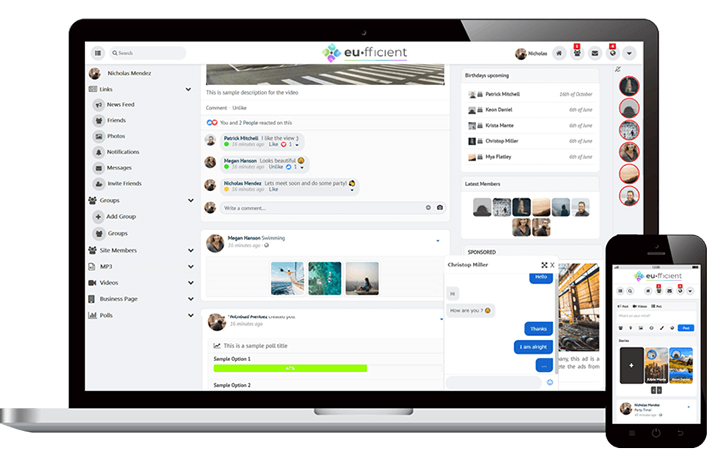
Innovators meet sparring and implementation partners online – with the common goal of developing solutions for complex challenges and bringing them to application more quickly. For industry, this means fewer detours in the innovation process, more knowledge and direct access to technologies and research resources. Annika Bastian, who played a key role in designing the platform at IPEK, is certain: "The structured exchange and targeted networking creates added value for everyone involved – a step towards sustainable technology transfer at the European level."
Strong partners, shared vision
EU.FFICIENT started in 2024 as an EU project with fifteen international partners from science, business and the public sector. The large and diverse project team shows a strong interest in Europe-wide transfer. The consortium partners are pursuing a common goal: bringing people together across national and disciplinary boundaries in a well-thought-out knowledge and innovation community. Bastian explains: "We want to facilitate networking between 'expert facilitators' within Europe – specifically anyone who can bridge the gap between research and industrial application. In practice, these may include not only researchers, but also technology transfer officers, employees from business development or research management, as well as people with management functions or very specific expertise in companies or the public sector." The platform has been online since July 2025 and is open to anyone who wants to shape innovation actively.
User journeys instead of gut feeling
To ensure that EU.FFICIENT creates real benefits, the consortium consistently focuses on user-centered development. As part of the international consortium, Annika Bastian and Christoph Kempf from the Design Methods and Design Management research group at IPEK played a leading role in shaping the development methodology for the platform design. Annika Bastian explains the process: "Together with students and colleagues, we developed the methodology — especially the systematic collection, modeling and iterative development of user journeys. We focused on the following questions: What do users really need? What roles and goals do our users have? And what is important to initiate real collaboration?" Instead of assumptions or individual opinions, concrete user needs and process flows form the basis for the platform design: on the one hand, the requirements of the network partners derived from experience and, on the other, the methodically developed needs of all stakeholders, which were elaborated using SWOT analyses and business model canvas, for example.
From benefit to product
"A method developed at the institute was particularly valuable for us, as it creates clarity about the benefits and objectives without anticipating technical solutions – the product profile," says method expert Bastian, adding: "This is a development method for a structured overview of the benefits a product should offer – for the provider, the customer and the user. Instead of immediately committing to a technical solution, a product profile defines an open framework in which creative work can be carried out and possible solutions can be weighed up. This enabled us to validate functions before they were fully integrated into the product." Potential users were involved in semi-structured interviews for the final selection of design options. This resulted in a needs-based solution whose initial features were programmed and validated in a beta version after coordination within the consortium.
Three pillars of use
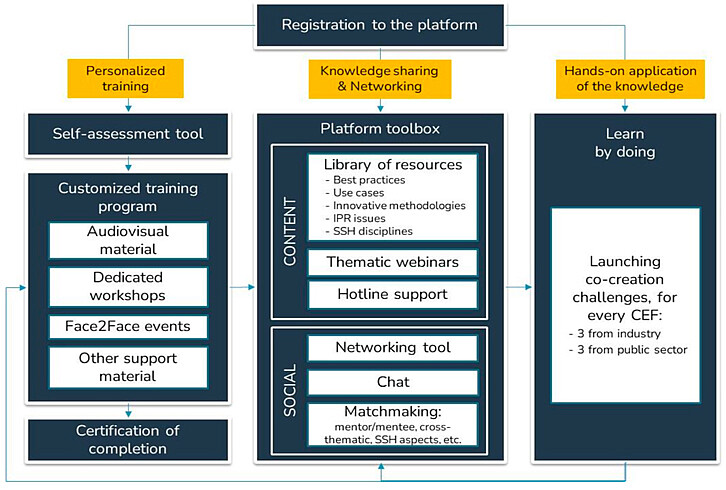
From the beginning, the project partners agreed on the basic direction for the development of the online platform. The platform is based on three central pillars of use:
- Personalized training: Interactive learning modules – online and face-to-face – supplemented by a self-assessment tool that determines the user's own individual training needs and suggests suitable workshops and modules.
- Knowledge sharing & networking: Networking in topic-specific, curated communities, targeted contact options (e.g. profiles, posts, private chats) and a community newsfeed that filters relevant content.
- Hands-on application of the knowledge: Proactive opportunities to call for or search for specific project ideas, mentoring relationships or content-related discourse.
Bastian emphasizes: "EU.FFICIENT is more than a social network, it is a learning environment, community and workspace at the same time. We want people to come together and evolve. Along four themed communities, so called Communities of Expert Facilitators (CEFs), members receive topic-specific content, networking opportunities and targeted inputs for exchange and co-creation." According to Bastian, personal exchange is a crucial component: "It was important to us that there are also offers, such as events and training modules, that take place in person. This allows participants to tackle examples or real use cases together and directly discuss the problem to be solved. Within a group, the person posting about a challenge not only receive feedback, but can also work on it together with the others. This is co-creation: achieving more together than would be possible individually."
Launch with four thematic communities
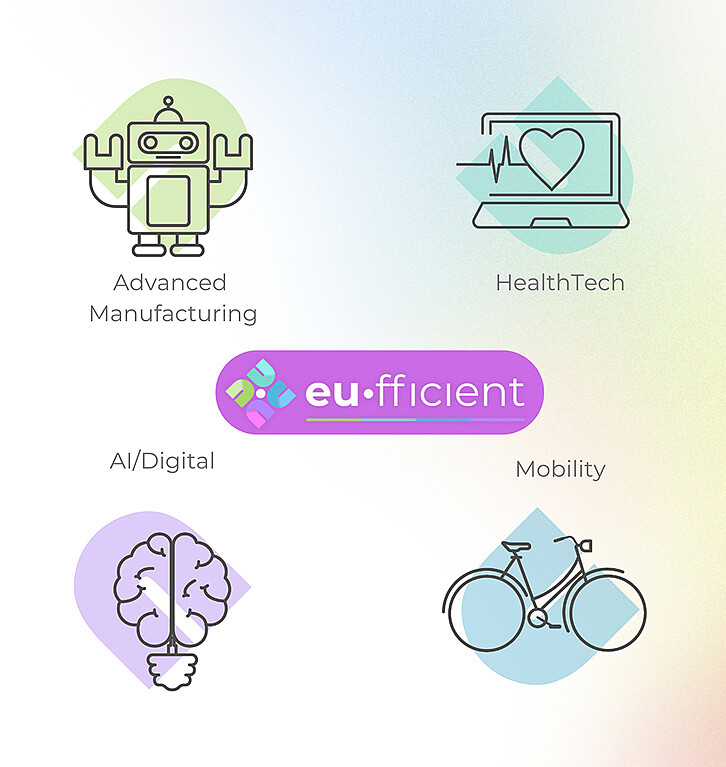
During concept and development phase, four thematic clusters emerged that are offered right from the launch of the platform: Advanced Manufacturing, Mobility, Health Tech and AI / Digital. Each of these communities has a dedicated moderator from the project consortium. IPEK is involved in the Mobility community. A considerable base of information and learning modules is already available. But it is not only the moderators and partners who contribute content. Every registered member can share training materials, presentations or project ideas, which are also available for other members following a quality assurance process. The platform grows with its users and remains open to new topics and formats. There are plans to expand to other topic clusters in the future.
Diversity as a driver of innovation
EU.FFICIENT creates a digital space for collaboration, simplifies access to scientific expertise and facilitates the initiation of cooperation projects. With the help of the wealth of experience and complementary skills of the users, a unique innovation environment is created. "Each group brings its own perspectives, skills and resources that complement each other. Science contributes the latest findings and technologies, companies the practical applications and market access and the public sector the direct social needs and regulatory knowledge. This diversity increases creativity and enables complex challenges to be solved," says Bastian, describing the interrelations.
Open source with clear rules
The online platform is based on an open source solution to continue development after the end of the project. Clear community guidelines ensure that data is handled securely. Bastian clarifies: "Only post what is allowed to be shared – this principle applies throughout the platform and we explain this to our members when they register. Sensitive content belongs in protected areas that comply with the relevant company guidelines. We offer various communication channels, but integrated functions such as Google Chat or Zoom do not necessarily have to be used." To the initiators of the platform it is essential that users pass over from an initial chat into work mode. If a match is successful, individual tools can be used for further collaboration.
An invitation to work together
EU.FFICIENT offers a new space in which ideas can not only be exchanged, but also further developed. If you want to do more than just network and would rather shape things together, this is the perfect place for you. The official launch marks the next stage: "We want to further develop the platform based on real user behavior," says Bastian. After all, EU.FFICIENT is not intended as a finished product, but as a living ecosystem that thrives on active participation and grows with its users.
EU.FFICIENT – Project facts
The EU.FFICIENT project is funded under Horizon Europe from 2024 to 2026 (project number 101135297). The project is coordinated by KU Leuven (Belgium). A total of 15 partners from 9 countries are working together to create a sustainable innovation ecosystem: KIT, CIT UPC (Spain), FPM (Italy), CentraleSupelec (France), UM (Slovenia), Tice.pt (Portugal), Flanders Make (Belgium), SVSPT (Lithuania), UIIN (Netherlands), EIT Manufacturing East (Austria), i2m Unternehmensentwicklung GmbH (Austria), CSES Europe (Ireland), Innoget (Spain) and the municipality of SKELLEFTEA (Sweden).
comments about this article
No Comments