ZEco Thermal Lab: Cooling and Heating with Solids
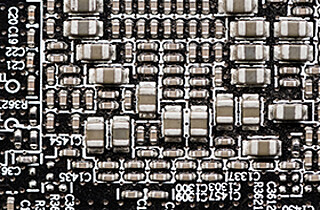
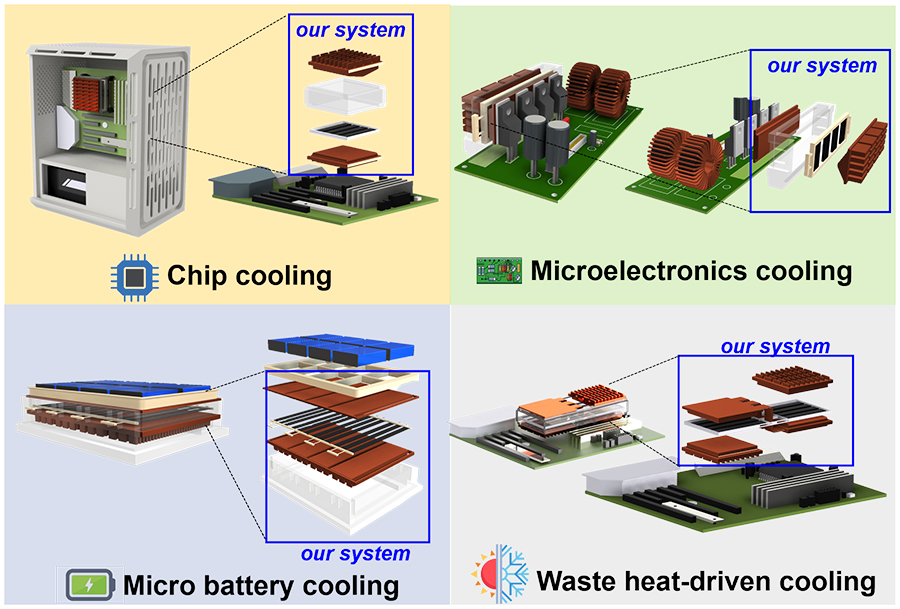
Microelectronic components such as chips, processors/CPUs, mini batteries, and sensors are used in computers, smartphones, cars, medical testing equipment, and other devices. Depending on where they are used – for example, in closed housings – they can heat up to over 80 degrees Celsius during operation and have to be cooled for optimal performance and service life. Their number is growing with technological progress.
State of the art
Until now, the increasing demand has been covered primarily by thermoelectric coolers that utilize the Peltier effect. In this process, a temperature difference is generated by applying direct current to numerous p- and n-doped pairs of semiconductor materials embedded between two ceramic plates. However, this method is not very energy-efficient due to its low cooling capacity and high power consumption.
Technology
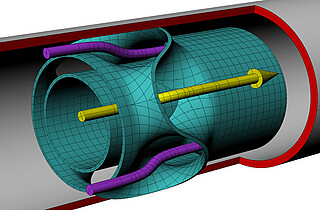
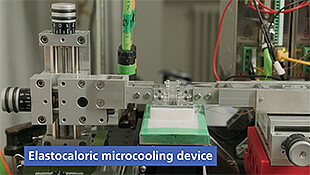
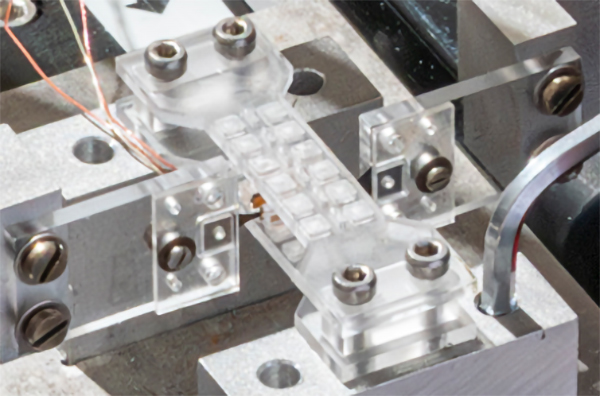
At the Institute for Microstructure Technology (IMT) at KIT, researchers at the ZEco Thermal Lab have developed a miniature cooling technology that doesn't need gaseous refrigerants that are harmful to the climate. It's based on the elastocaloric effect, where a temperature change occurs through the deformation of solid materials. ZEco uses a nickel-titanium shape memory alloy. When tensile stress is applied to the material by mechanical force, the atoms in the crystal lattice change their arrangement. This restructuring releases heat, which is conducted to the environment via a heat exchanger – in this case, a copper plate – and dissipated. When the stress is subsequently released, the material returns to its original shape and cools below its initial temperature. Contact with the relevant microelectronics achieves a cooling effect by absorbing heat. Repeating this charging and discharging cycle creates a continuous heat pump cycle that can function as a cooling and/or heating system.
Advantages
Solid refrigerants, such as those used at KIT, have no global warming potential and are therefore climate-friendly. The use of superelastic shape memory alloys results in high material efficiency and a long service life (> 10 million cycles).
Options for companies
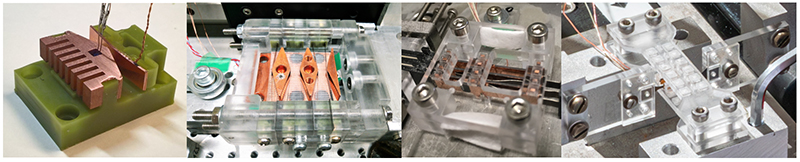
ZEco Thermal Lab has developed several prototypes of elastocaloric microcoolers for temperature management in microelectronics in various areas of application. Industrial partners from the electrical, medical device, and automotive industries are being sought to validate the process in real-world process environments and adapt the design accordingly.
Images close open
Your contact person for this offer

Innovation Manager New Materials and Health Technologies Karlsruhe Institute of Technology (KIT)
Innovation and Relations Management (IRM) Phone: +49 721 608-26107
Email: jan-niklas.bloetz@kit.edu