Physically recycling rare earths and other raw materials
Recycling is becoming increasingly important – and at the same time more challenging: The electronics and semiconductor industries, high-tech recycling, and mining generate large quantities of waste materials that contain valuable raw materials in the form of tiny particles. Rare earth metals such as terbium and yttrium are in particularly high demand. These are found, for example, in screens, end-of-life fluorescent tubes, and high-tech products.
State of the art
Recovering such raw materials is costly. Existing methods mostly use expensive chemical processes that generate additional waste. On the other hand, complex sorting processes reach their limits, especially with nano- and microparticles, because precise and, above all, continuous separation of the particles is virtually impossible.
Technology
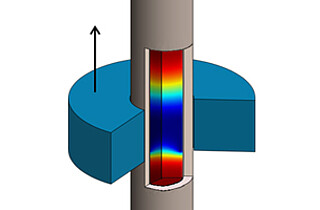
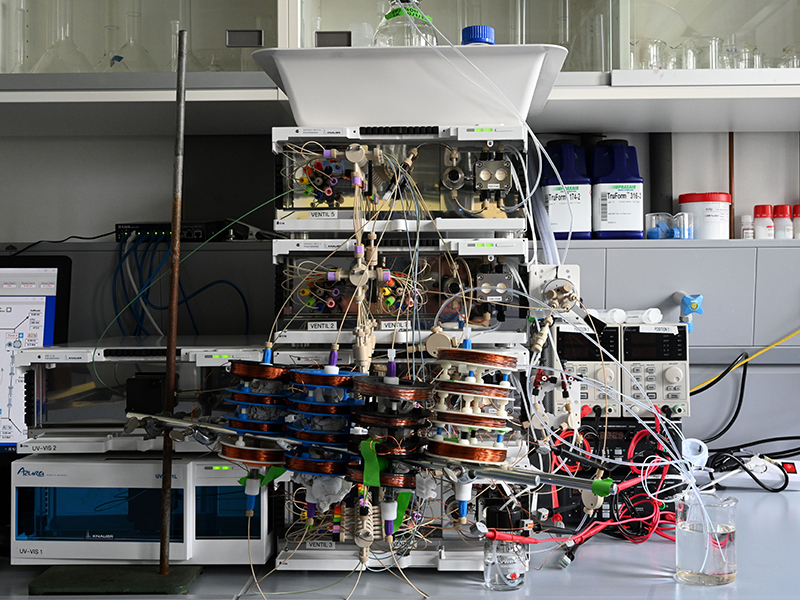
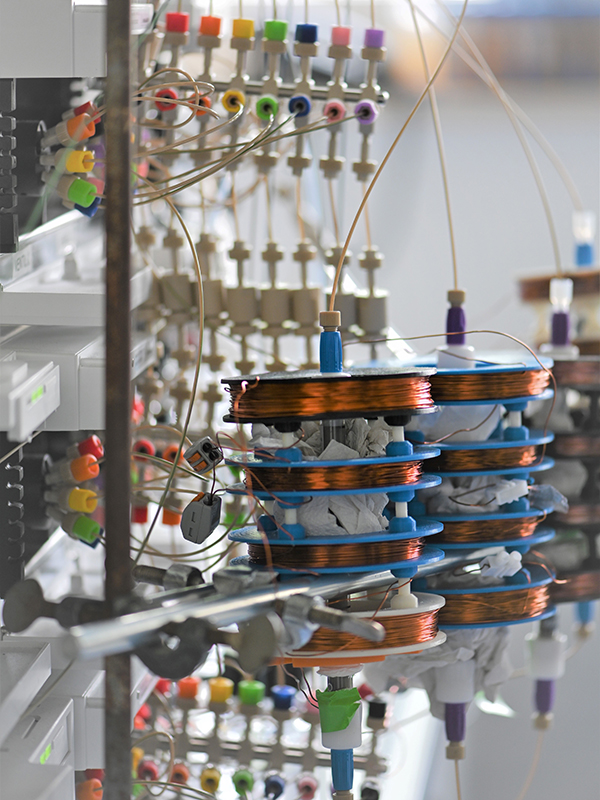
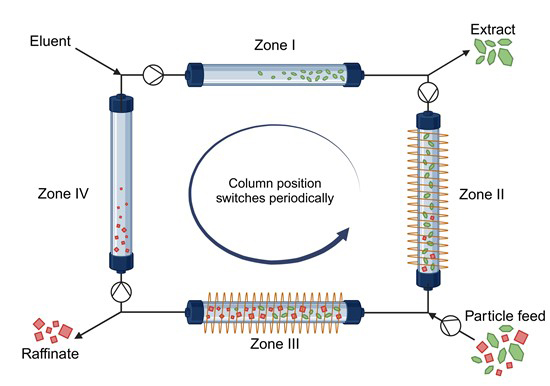
Researchers at the Institute for Functional Interfaces (IFG) at KIT are therefore focusing on precisely this point: they use the principle of magnetic field-controlled chromatography to separate waste mixtures efficiently, in continuous operation, and without the use of aggressive acids. The process is based on the countercurrent principle and works with special separation columns filled with tiny magnetizable beads, e.g., steel balls. While the waste mixture flows through the individual columns in a fluid, magnetic coils positioned along each column generate a targeted magnetic field. The process takes advantage of the fact that the particles react differently to this: some remain stuck between the beads for longer, while others rush through more quickly. They therefore have a longer or shorter “retention time.” As a result, the particles separate spatially and can be continuously extracted as almost pure fractions.
Advantages
With a column system consisting of at least three columns and cyclically switched inputs and outputs, the process operates continuously and processes large quantities of waste mixtures. It does not require any aggressive chemicals. The process is therefore very gentle, keeps the particles intact, and avoids toxic residues. This unique process combines ecological benefits with economic efficiency, making recycling cleaner and more cost-effective.
Options for companies
The principle can be applied in all areas where para- or ferrimagnetic technical nanoparticles need to be produced or separated from natural or synthetic mixtures. For industrial implementation, KIT is looking for partners for cooperation, licensing, and further development of the process.
Images close open
Your contact person for this offer

Innovation Manager New Materials and Health Technologies Karlsruhe Institute of Technology (KIT)
Innovation and Relations Management (IRM) Phone: +49 721 608-26107
Email: jan-niklas.bloetz@kit.edu