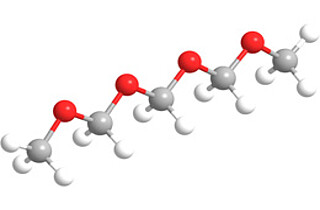
AI Soot Check for Fuels
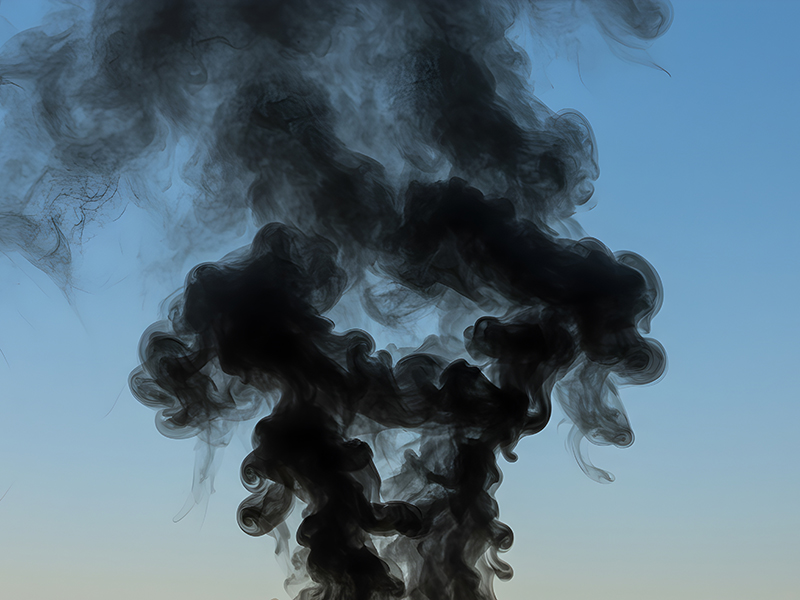
Contrails in the sky appear harmless, but they are a serious climate problem: fine soot particles at high altitudes act as nuclei for ice crystals, which reflect heat radiation back to Earth. On the ground, soot emissions from fossil and synthetic fuels also degrade air quality and can cause health damage.
State of the art
The Yield Sooting Index (YSI) indicates how strongly a fuel forms soot. It is important for energy-intensive industries such as aviation, automotive, and chemistry, as well as for the development of clean fuels and propellants. The conventional experimental determination of the YSI relies on tests in complex laboratory apparatus with costly laser measurement technology. This approach involving combustion tests is time-consuming (measurement duration often several hours) and requires extensive expertise, which hinders widespread use.
Technology
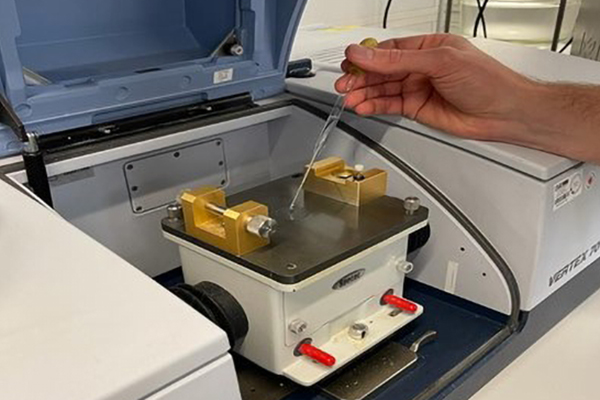
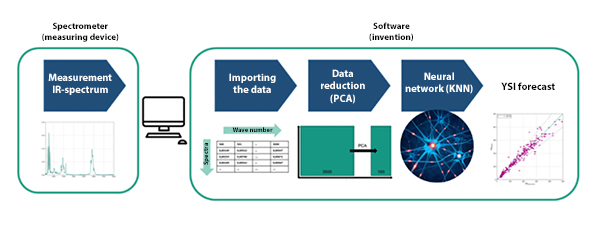
Researchers at KIT’s Engler-Bunte Institute have succeeded in developing an AI-based model that predicts the YSI directly from infrared spectra of fuel samples using a Kohonen Neural Network (KNN). Only a few drops are needed for measurement. The principle is simple: a Fourier-Transform Infrared (FTIR) spectrometer provides a characteristic spectrum for each sample – a kind of "fingerprint" of the fuel. Then AI comes into play: the KNN, trained with over 300 mixtures and pure substances from various substance groups (n/iso-paraffins, naphthenes, and aromatics), forms the core of the process. The intelligent analysis recognizes patterns in the spectra and thus reliably and precisely predicts the sample's YSI.
Advantages
The FTIR technology used is comparatively inexpensive and can be found in almost every analytical laboratory. The measurement duration is only a few minutes per sample, enabling rapid iterations and screenings. Due to the small sample volume required, the method is ideal for research laboratories with limited material availability.
Options for companies
In addition to YSI prediction, the AI-based model offers potential for determining other physicochemical fuel properties such as density, viscosity, flash point, or cloud point. The method is flexibly scalable and can be further improved with a growing database through new training samples, e.g., by extending it to include oxygenates. KIT is seeking partners for application-specific development projects and collaborative research.
Images close open
Your contact person for this offer

Innovation Manager Karlsruhe Institute of Technology (KIT)
Innovation and Relations Management (IRM) Phone: +49 721 608-25587
Email: rainer.koerber@kit.edu