Research truck for hydrogen technologies
New drive systems are a central theme of the mobility transition. In addition to purely battery-electric solutions, fuel cell systems are increasingly coming into focus, especially for applications with high energy requirements.
State of the art
The PEM (Proton Exchange Membrane) fuel cell has emerged as a suitable fuel cell solution for mobility applications, as it operates at low temperatures (approx. 80 degrees Celsius) and is characterized by a fast response and high power density. Nevertheless, there is still a need for development, particularly in the optimization of system components, the interaction between battery and fuel cell (BSZ) and the operating strategy.
The technology
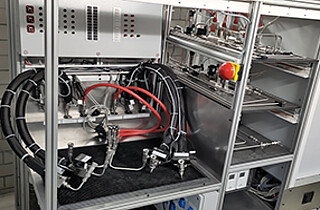
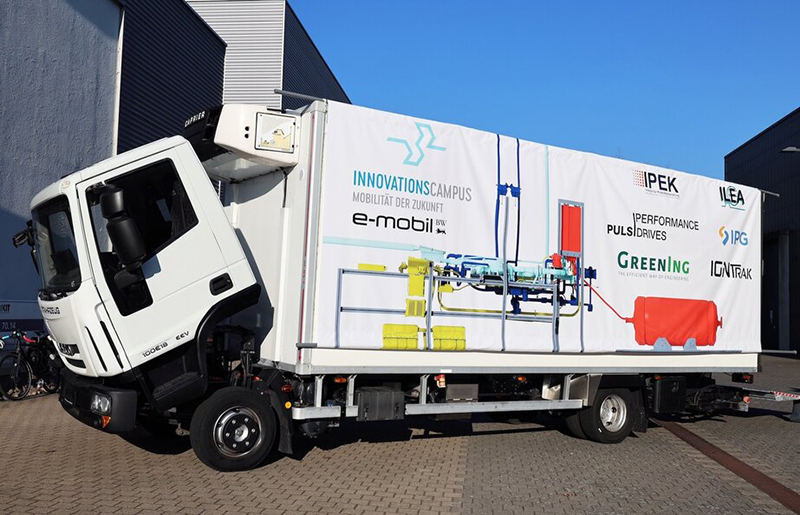
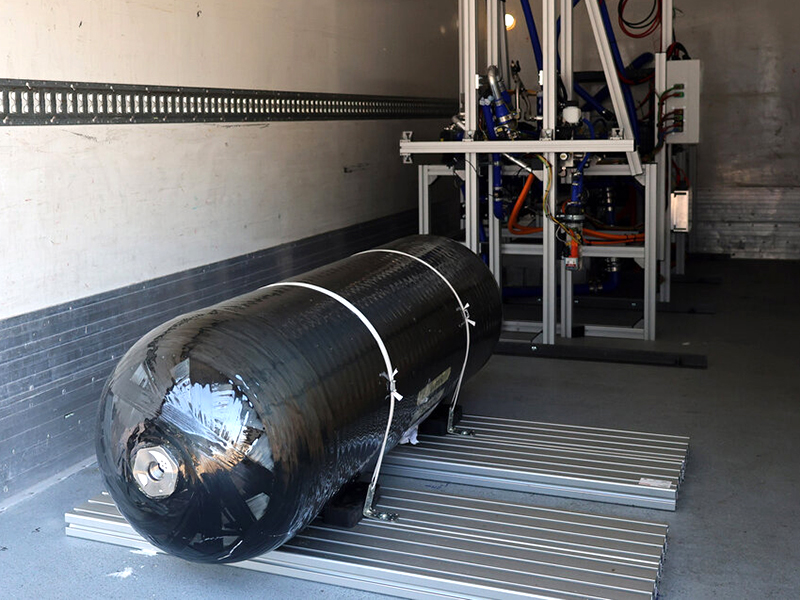
A mobile research truck of the ICM (Innovation Campus Mobility of the Future) was developed to accelerate the further development and optimization of future fuel cell generations under various application scenarios. The truck is equipped with a modular fuel cell system (PEM) and battery system as a hybrid system. The BSZ system, including the hydrogen tank system, is installed in the box body of the truck, which ensures good accessibility. Components such as the air compressor, BSZ stack and sensors can be quickly integrated, replaced or individually adapted. Depending on the driving situation, power can be supplied from the BSZ, the battery or a combination of both. The moving laboratory measures power flows, temperatures, pressures and humidity in detail at various system points. Mixed physical-virtual validation allows real and virtual test scenarios to be flexibly combined.
Advantages
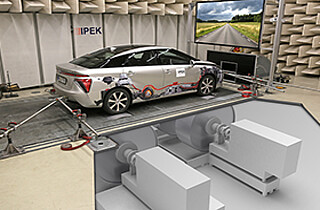
The research truck enables flexible and practical testing in real driving operations. The open test platform allows tests with BSZs and batteries of different sizes (hardware) as well as different energy management and operating strategies (software) for individual measurement tasks. In contrast to laboratory test benches, the truck also experiences real environmental influences such as vibrations and fluctuations in temperature and humidity.
Options for companies
Industrial partners can test their own components or control concepts from an overall system perspective, either as part of research projects or as contract research. The offer is suitable for companies that want to benefit from the open, modular and practical test environment and validate new developments in a practical manner.
Images close open
Your contact person for this offer

Innovation Manager Mobility and Information Karlsruhe Institute of Technology (KIT)
Innovation and Relations Management (IRM) Phone: +49 721 608-25335
Email: julia.rast@kit.edu