Install weather sensors including extension arms by drone
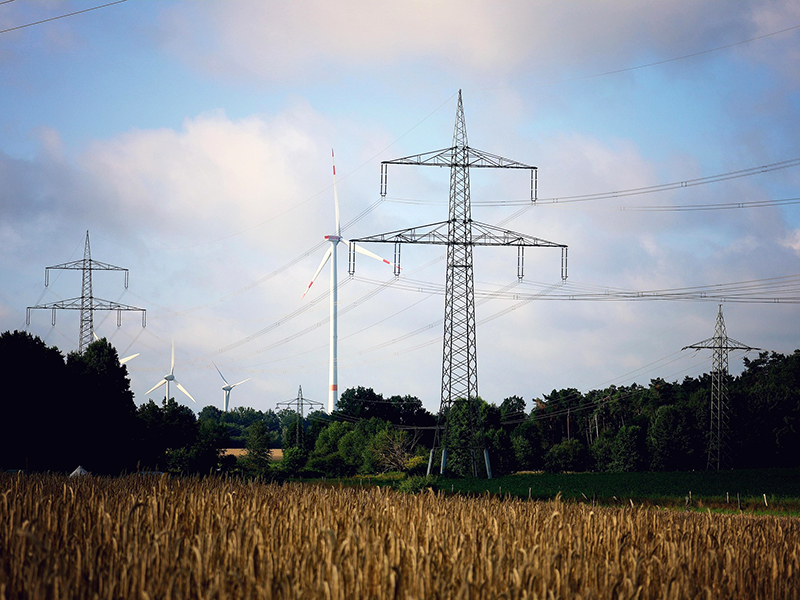
In 2024, Germany was the European country with the highest electricity generation from wind energy – wind now produces 29 percent of the total gross electricity. Due to the fact that more electricity is generated in the north of the country than is needed there, north-south transmission is increasing and causing bottlenecks in the transmission lines. Their transmission efficiency is extremely dependent on weather conditions, so these have to be recorded as accurately as possible.
State of the art
This is done by sensor stations mounted on the power poles near the overhead lines to register solar radiation, air cooling and the like, and thus calculate the weather-dependent dynamic current-carrying capacity. According to the current state of the art, additional measuring poles are set up or sensors are bolted to the power poles for this purpose. Climbers and often large crane systems are used for this. The lines have to be switched off for safety reasons, which is rarely the case even during maintenance work. As a result, implementing a distributed sensor network is very time-consuming and risky.
Technology
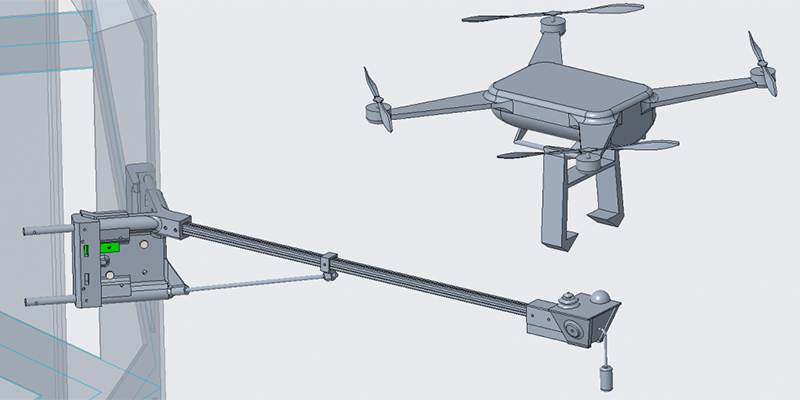
In order to quickly and safely mount sensors at great heights, researchers at the Institute for Information Processing Technology (ITIV) at KIT have developed an installation approach in which assembly and disassembly are carried out directly on the power pole using a drone. The drone is equipped with a gripper arm that carries an extension arm. Instead of screws, magnets and clamping mechanisms are used to attach the extension arm to the pole. The magnets align the extension arm with the power pole, and the clamps enclose it. The torque generated wedges the extension arm and holds it firmly in position. It features a kind of collection basket into which the drone can unload the sensor housing and from which it can pick it up again, for example to replace the batteries.
Advantages
With the new installation concept, significantly more sensor nodes can be installed in the same period of time. For this, technicians do not have to be put in danger, nor do crane systems have to be provided, additional measuring poles have to be set up or lines have to be disconnected. The concept is not only interesting for grid operators and their measurement technology suppliers, but for all companies that want to attach sensors at inaccessible heights.
Options for companies
KIT is looking for partners in the fields of measurement and sensor technology, meteorology and energy supply to further develop the approach and bring the invention to industrial maturity.
Images close open
Your contact person for this offer

Innovation Manager Mobility and Information Karlsruhe Institute of Technology (KIT)
Innovation and Relations Management (IRM) Phone: +49 721 608-25335
Email: julia.rast@kit.edu